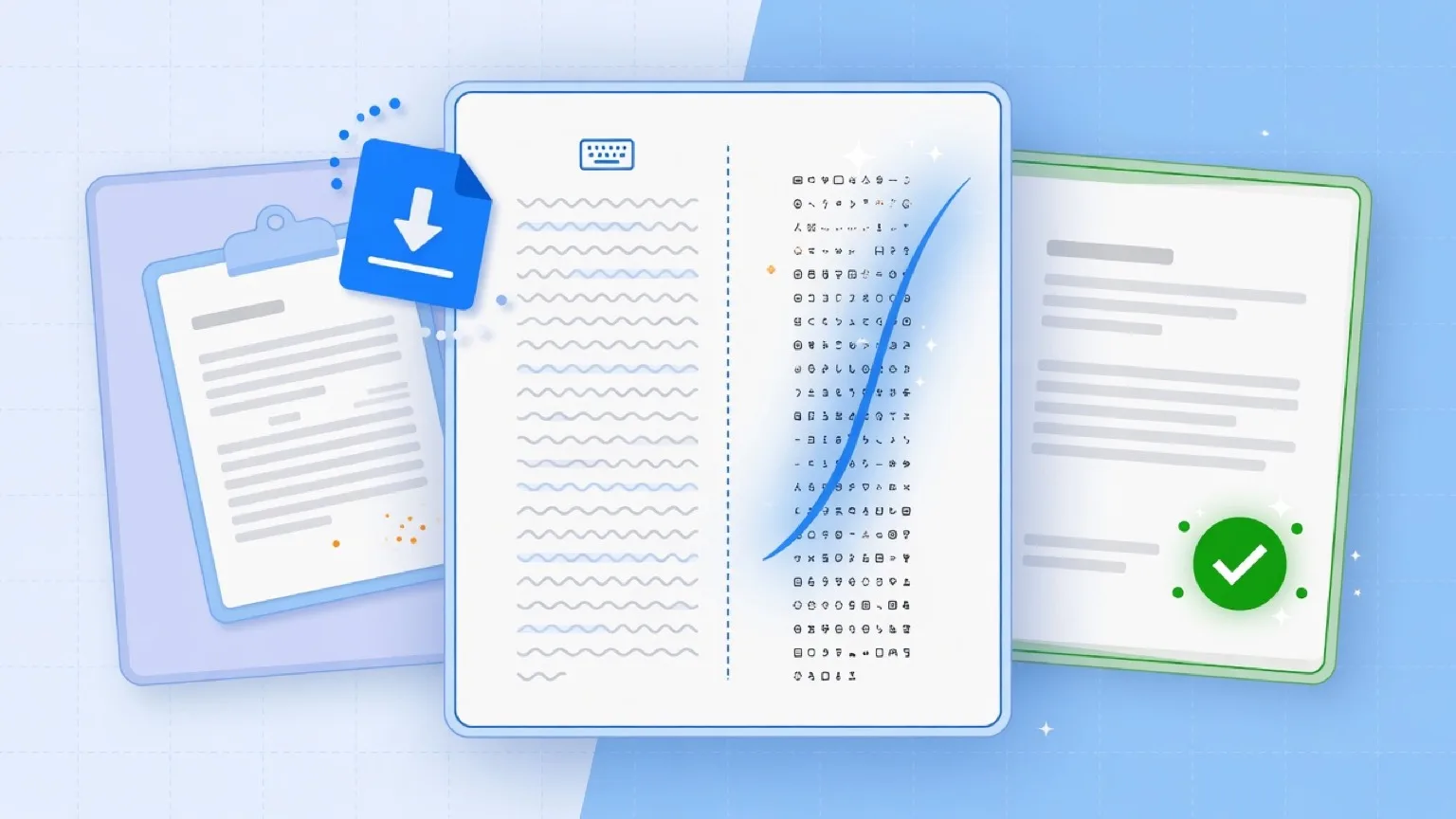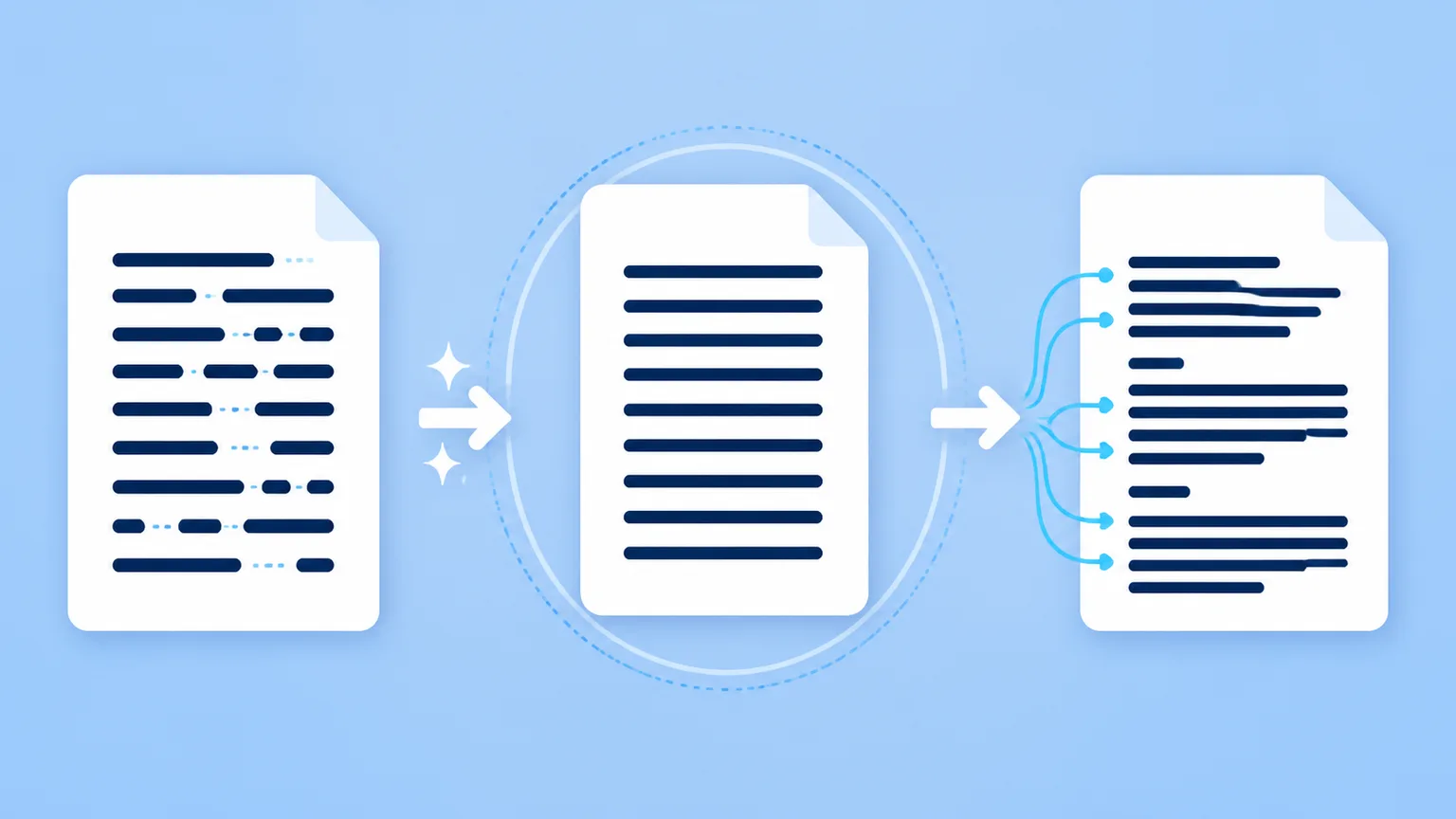
In the world of AI text processing, local character sanitation is the essential first step. Stripping invisible Unicode code points (like zero-width joiners and narrow no-break spaces) and removing unrendered markdown tags restores clean typography and fixes document glitches.
However, content creators and professional writers often encounter situations where a draft looks physically clean, yet still suffers from deeper stylistic issues.
When your text exhibits mechanical repetition, predictable clause structures, or statistical model patterns, surface-level byte stripping reaches its limits. In this guide, we explore the boundary between character sanitation and semantic reconstruction, showing you when and how to elevate your text.
The Boundary: What Character Cleaning Can and Cannot Do
To use the right tool for the job, you must understand the technical boundary of character-level sanitation.
What Character Cleaning Solves Perfectly
- Byte Sanitation: Stripping non-printing Unicode characters (
U+200B,U+200C,U+200D,U+FEFF). - Whitespace Normalization: Replacing narrow non-breaking spaces (
U+202F) with standard ASCII spaces (U+0020). - Markdown Flattening: Removing raw heading hashes (
#), bold asterisks (**), and blockquotes (>) to output plain text. - Formulas and Parser Compatibility: Ensuring Excel formulas, database strings, and CMS fields parse without silent errors.
What Character Cleaning Cannot Address
- Syntactic Monotony: Monotonous subject-verb-object sentence structures repeating across every paragraph.
- Formulaic Transitions: Clichéd connector words (e.g., "Furthermore", "Moreover", "In summary", "It is crucial to remember").
- Statistical Token Watermarks: Model-level sampling biases (such as Anthropic's Claude official watermark), which reside in vocabulary probability distributions rather than hidden bytes.
- Tone and Voice Cadence: Rigid, robotic tone that fails to engage human readers or reflect your authentic brand voice.
Three Signs Your Draft Needs Semantic Reconstruction
When evaluating drafts generated or assisted by AI models, look for these three clear indicators:
1. The "Robotic Cadence" Problem
Language models tend to generate sentences of roughly equal length, creating a metronomic reading experience. Human writers naturally alternate between short, punchy statements and expansive, multi-clause thoughts.
- The Symptom: Your paragraphs feel mechanically balanced, predictable, and devoid of energetic rhythm.
2. Overuse of Stereotypical Vocabulary
AI models consistently over-index on specific academic or corporate vocabulary. Phrases like "delve into", "testament to", "multifaceted tapestry", and "pivotal role" immediately signal machine generation.
- The Symptom: The draft communicates the core idea, but sounds like a standard corporate brochure rather than a genuine human voice.
3. Statistical Attribution & Perplexity Signatures
Advanced language models (including Claude 3.5 Sonnet) use probabilistic sampling methods that introduce mathematical patterns into word selection.
- The Symptom: While zero hidden characters exist in the text, statistical analysis can verify the presence of model-specific sampling distributions.
The Two-Tier Approach to AI Text Hygiene
At Clean Paste AI, we advocate for a structured, two-tier workflow that respects both privacy and editorial quality:
Step 1: Free Local Sanitation
[Copied AI Draft]
   └──> Strip U+202F, ZWSP, Markdown (100% In-Browser, Instant & Free)
        └──> Mechanically Clean Plain Text

Step 2: Pro Semantic Reconstruction (Optional / As Needed)
[Clean Plain Text]
   └──> Evaluate Style & Context
        ├── If Technical/Internal Notes ──> Ready to Publish
        └── If Long-Form/Editorial/Public ──> Pro Rewrite (Restructure Sentences, Vary Cadence)
Tier 1: 100% Free Local Sanitation
Every workflow should begin with Tier 1. Running your text through an in-browser scanner ensures that no hidden Unicode characters or formatting tags corrupt downstream applications. This step is completely free, runs locally in your browser, and requires no account.
Tier 2: Pro Meaning-Preserving Reconstruction
When a piece of writing is destined for high-visibility channels—such as client proposals, published articles, academic papers, or marketing campaigns—Tier 2 takes your draft across the finish line:
- Meaning Preservation: The core message, arguments, and factual statements remain strictly intact.
- Dynamic Phrasing: Monotonous clauses are reorganized into varied, expressive sentence structures.
- Natural Vocabulary: Cliche filler phrases are replaced with organic, conversational equivalents.
- Statistical Disruption: By completely rewording sentences, sampling watermark distributions are naturally transformed.
Comparison: Sanitation vs. Semantic Reconstruction
| Feature | Tier 1: Local Character Sanitation | Tier 2: Pro Semantic Reconstruction |
|---|---|---|
| Primary Goal | Physical document hygiene & layout safety | Stylistic elevation & natural human cadence |
| Modifies Visible Words? | No (words remain identical) | Yes (rephrases sentences while keeping meaning) |
| Removes Invisible Code Points? | Yes (U+202F, U+200B, U+FEFF, etc.) | Applied after physical cleaning |
| Alters Statistical Watermarks? | No (mathematical distribution unchanged) | Yes (restructures token distribution) |
| Speed & Privacy | Instant (<5ms), runs 100% in local browser | Secure cloud neural rewrite, fast turnaround |
| Cost | 100% Free, unlimited usage | Free 500-word trial; flexible credit packs |
Conclusion
Text hygiene is not an all-or-nothing decision. For spreadsheets, code, and quick notes, surface-level character cleaning is all you will ever need. But when your writing demands genuine warmth, dynamic rhythm, and authentic human cadence, combine local sanitation with thoughtful semantic reconstruction.